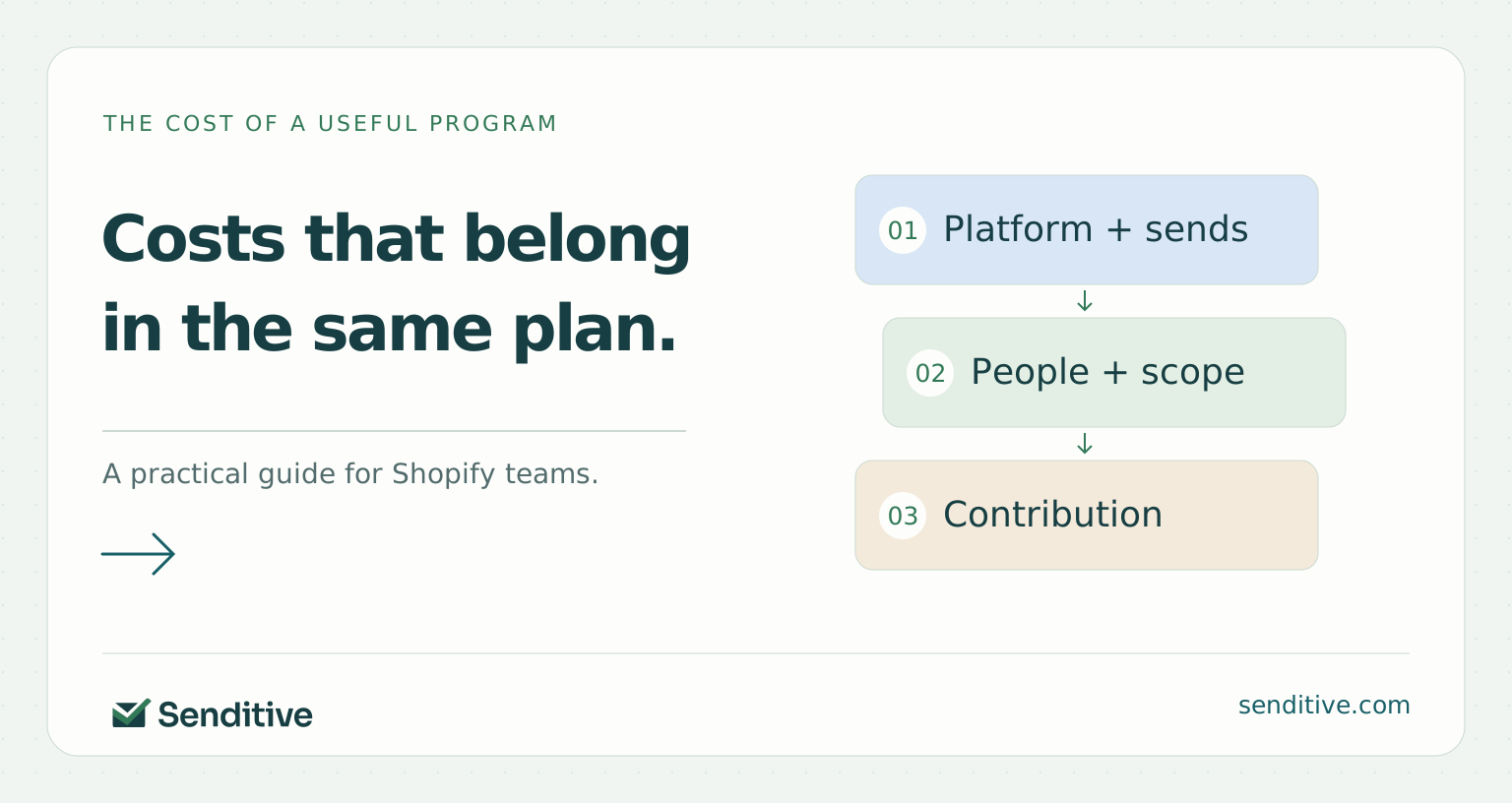
A monthly email platform invoice is only one part of running a useful retention program. Someone still needs to plan the messages, write and design them, build reliable automations, maintain signup forms, approve work, and explain what the results mean. Comparing tools or proposals without those responsibilities produces an incomplete budget.
The useful question is what it costs to operate the program your store actually needs. This guide separates recurring work from setup, cash spending from internal capacity, and platform-attributed sales from the contribution available to pay for the work. The tools use your own assumptions rather than presenting an agency price as a universal market rate.
Define the program before asking for a monthly price
Start by listing the customer moments and recurring work you want covered. A store with working welcome and recovery flows may need campaign planning and maintenance. Another store may need its foundations repaired before a regular sending calendar makes sense. Those are different projects, even when both are described as email marketing.
Record the outputs you expect: which automations, how many messages within each, campaign cadence, signup forms, channel scope, reporting, and approval support. Include responsibilities after launch. A flow that is built once but never reviewed is a different service from a flow monitored and updated as products, offers, and customer behavior change.
Give the budget a time horizon. Separate the first implementation period from a normal operating month and a seasonal peak. This prevents setup costs from making ongoing work look unusually expensive, and stops a low monthly retainer from hiding a substantial launch bill. Before comparing providers, decide which work is essential now and which can wait until the program has a dependable owner.
Understand the platform billing unit
Platform charges do not all grow for the same reason. Klaviyo describes its month-to-month Profile & Email model in terms of active profiles and included send capacity, with billing preferences affecting changes in usage. Its text messaging plan is separate. Check your account's actual agreement and settings rather than treating a public pricing example as your invoice.
Shopify Messaging documents email usage by recipient send. Sending a campaign to several thousand recipients consumes several thousand sends, rather than one campaign unit. Marketing automation emails also affect usage, subject to the documented exceptions. Read the current pricing page before forecasting a busy month because allowances, tiers, and product terms can change.
Do not confuse a billable or active profile with a marketing subscriber. Consent, suppression, and sending eligibility require their own review. Estimate the audience and messages your program can appropriately reach, then map that usage to the platform's current billing model. Reducing a database count without understanding the affected customer journeys can create an operational problem while appearing to save money.
Reference: How pricing works; Active email profiles; Messaging email pricing.
Forecast campaigns and automations together
Build the usage estimate from a sending plan. For campaigns, multiply the intended audience by the planned number of sends, allowing for the fact that different campaigns may target different groups. For automations, estimate entrants and the messages they are likely to receive. Keep those estimates separate so you can see which assumption changes the bill.
Do not multiply every flow entrant by every message without considering purchase exits, eligibility, delays, and intentional skips. Klaviyo's Smart Sending can skip a recent contact within a channel, and skipped messages are not automatically rescheduled. That means your production send count may differ from the number of boxes in a flow diagram.
Reference: Smart Sending.
Put it into practice
Email program budget planner
Separate recurring cash, internal time, and setup
Use your current quotes and planning assumptions. All money fields are USD. Zero means no cost in this scenario; an unknown quote should be resolved before deciding.
 senditive.com
Separate agency scope from a headline retainer
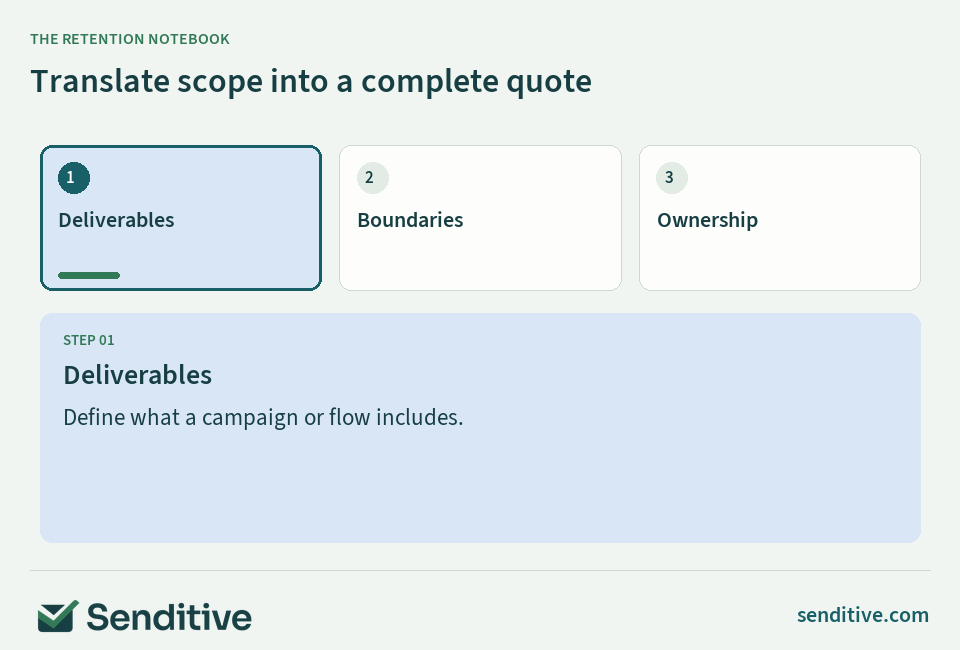
An agency fee is meaningful only alongside the work it buys. Strategy, copy, design, production, quality checks, testing, maintenance, and reporting can be included, limited, or charged separately. Ask for the actual deliverables and the meaning of a campaign, a flow, a message, a revision, and a form improvement.
Clarify which channels are included. Email and SMS can share planning, but they have different production, consent, usage, and operational requirements. A proposal that mentions retention may still exclude SMS, signup forms, or substantial automation rebuilds. Identify those boundaries before assuming two proposals cover the same program.
Compare what happens when the agreed plan changes. Find out how additional creative, urgent promotions, new product launches, localization, or technical troubleshooting are priced and approved. Ask for the person who will make those decisions with you. A more useful comparison is the total cost of a defined workload, with its limits visible, rather than the lowest number on the first page.
Include the internal work that remains
Managed services do not remove every responsibility from the merchant. Your team still supplies accurate product information, commercial decisions, inventory constraints, and approval. Someone must answer questions about an offer, confirm a deadline, and resolve issues that belong to the store, support team, or developer. Put those hours into the operating plan.
Estimate internal time using a consistent hourly cost or a clearly stated planning value. Keep it separate from cash spending so the budget does not imply that every internal hour is a new invoice. The distinction helps compare an agency, a freelancer, an employee, and a founder-managed approach on the same basis.
Access administration belongs in that workload too. Shopify collaborator permissions and Klaviyo user roles let you grant appropriate access without surrendering account ownership. Agree who maintains users, billing, integrations, and the sending domain. Unclear ownership often creates delays that no creative allowance can solve, particularly when a launch depends on another team's approval or technical change.
Use a free consultation to discuss the workload your team can support and the responsibilities worth placing with a managed service.
Take the proposed campaign cadence and list every merchant decision it needs: offer, product availability, product facts, image approval, and final send approval. Put a named role beside each item and estimate the time across a normal month. Then repeat the exercise for the peak plan. If one person owns every approval, ask whether the deadline is realistic before pricing additional campaigns. This exercise can reveal a capacity constraint that a larger creative allowance will not solve. Keep the internal-time estimate beside the cash budget rather than combining them without explanation.
Reference: Collaborator accounts; User management and privileges.
Budget for setup, migration, and occasional repairs
One-time work can include account review, data mapping, template systems, new automations, form builds, and migration. These tasks vary with the starting account. A documented, well-maintained program is different from an account with duplicated flows, uncertain consent records, or several disconnected apps. Ask how the initial assessment changes the implementation plan.
Integration work needs explicit acceptance checks. The Shopify–Klaviyo connection has settings for data, subscriber destinations, and onsite tracking; installing an app alone does not demonstrate that every intended path works. A migration budget should include testing, ownership transfer, and a controlled transition between sending systems.
In the calculator, show setup as an upfront cost and, separately, as an amount spread across a chosen planning period. Spreading a fee helps compare options, but it does not change when cash is due. Keep a reserve for known uncertainties rather than inventing a universal contingency percentage. When a repair is discovered, require a clear description and approved estimate before it becomes unbounded work.
Reference: Getting started with Shopify.
Put it into practice
Proposal cost comparison
Normalize two quotes over the same period
Use your current quotes and planning assumptions. All money fields are USD. Zero means no cost in this scenario; an unknown quote should be resolved before deciding.
senditive.comAccount for the tools and commercial costs around sending
Inventory the other apps supporting the program. A popup app, review integration, loyalty tool, analytics product, or extra design service may be necessary for your intended workflow. Some may already be part of the wider store budget. Mark shared costs separately so email is not charged for the same subscription twice.
Discounts and gifts are also commercial costs, although they are not software invoices. If a signup offer reduces the margin on orders, keep that effect visible when judging the program. Do not add discount cost again if your net revenue or contribution calculation already includes it. Consistent definitions matter more than a long spreadsheet of overlapping expense labels.
Compare proposals over the same period and workload
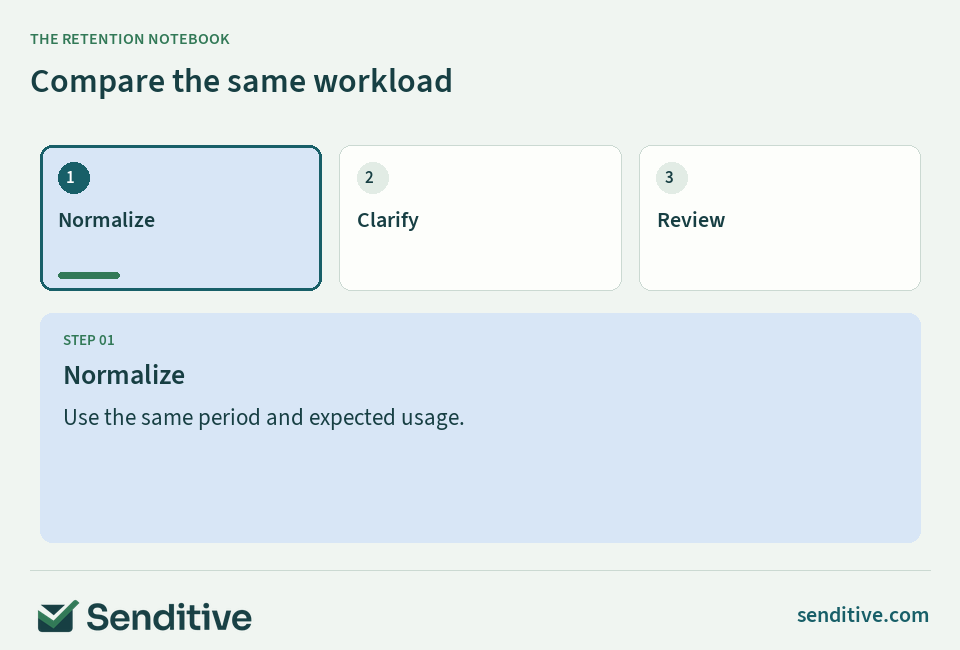
Normalize each option to the same period. Put setup, recurring fees, expected platform usage, supporting tools, and internal hours into one view. If one provider offers a smaller scope, record the missing work rather than assuming it costs nothing. If another includes useful work you do not need yet, identify that difference too.
Consider the work at normal capacity and at peak capacity. Ask what the provider needs from you to meet deadlines, how many review rounds are included, and what happens when approvals arrive late. A low price with a production process your team cannot support is not a dependable operating plan.
Keep uncertainty visible in the comparison. Use ranges or an unpriced line where a quote is still required. Do not fill the gap with an internet average that has a different scope, market, or service model. The proposal comparison tool helps list the categories consistently; the contract and direct answers from each provider remain the evidence for the actual price.
Check the contribution needed to cover the program
Revenue credited to email is not the same as additional profit generated by email. Some recipients would have ordered anyway, and platform attribution applies a reporting rule rather than observing that alternative outcome. Use attributed revenue to understand the reporting view, then ask a separate commercial question about the contribution available to cover program costs.
A simple planning calculation divides the cost you want covered by an assumed contribution margin expressed as a decimal. The result is the additional net sales required under that assumption. It is a threshold, not a forecast. If the margin is zero or negative, adding sales does not solve the cost problem in that model.
State what contribution includes: product cost, payment fees, fulfillment, returns, and incentive treatment where relevant. Compare several plausible assumptions and avoid treating every credited order as incremental. If the threshold looks unrealistic for the audience and purchase cycle, reduce scope, improve the economics, or reconsider the investment before demanding an unsupported revenue promise.
Reference: Message attribution.
Put it into practice
Contribution coverage threshold
Calculate the extra net sales a cost assumption needs
Enter your commercial assumptions. This is a cost-coverage threshold, not a sales or ROI forecast.
senditive.comReview the budget as an operating decision
Choose a plan that your store can execute and review. Assign an owner to spending, scope changes, approvals, and the monthly performance discussion. Record the current platform tier, billing preferences, service boundaries, and work that remains in-house. That document makes a future invoice easier to explain.
Revisit the model when the audience, product catalog, campaign cadence, or geography changes. Do not expand into another channel simply because the platform supports it. Add the work when there is a useful customer purpose, appropriate eligibility, enough capacity, and a way to judge the result. Smaller programs can be sensible when their foundations are reliable.
Keep the next review practical: what did you spend, what work was completed, what customer outcomes are visible, and what evidence is still missing? A free consultation with Senditive can help you discuss those priorities and a personalized roadmap. The aim is a budget that supports deliberate work, rather than an impressive collection of tools and messages without a clear owner.
Your questions, answered
How much should a Shopify brand pay an email marketing agency?
There is no useful universal fee without a defined scope. Compare strategy, creative, production, campaigns, flow work, forms, maintenance, reporting, revisions, and merchant responsibilities. Ask for a quote that separates setup from recurring work and names additional charges.
Are platform fees normally included in an agency retainer?
That depends on the proposal. Confirm who owns and pays for each account, and whether usage, SMS, supporting apps, or migration are included. Direct ownership of your accounts makes billing and a future handoff easier to manage.
Can I use attributed revenue to calculate agency ROI?
You can report attributed revenue alongside cost, but the ratio does not establish causal ROI. Attribution uses platform rules. A commercial assessment also needs contribution economics and evidence about orders the program added rather than merely received credit for.
Should I suppress profiles just to lower platform costs?
Review consent, engagement, customer value, and lifecycle needs before changing eligibility. Suppression and deletion have different operational effects. Use the current platform billing rules and your account settings, and do not remove important recipients simply to reach a lower-looking count.
Choose your next improvement
A realistic budget makes the work, ownership, and economics visible. Compare complete programs, keep setup separate from ongoing operations, and revisit assumptions when the store changes.