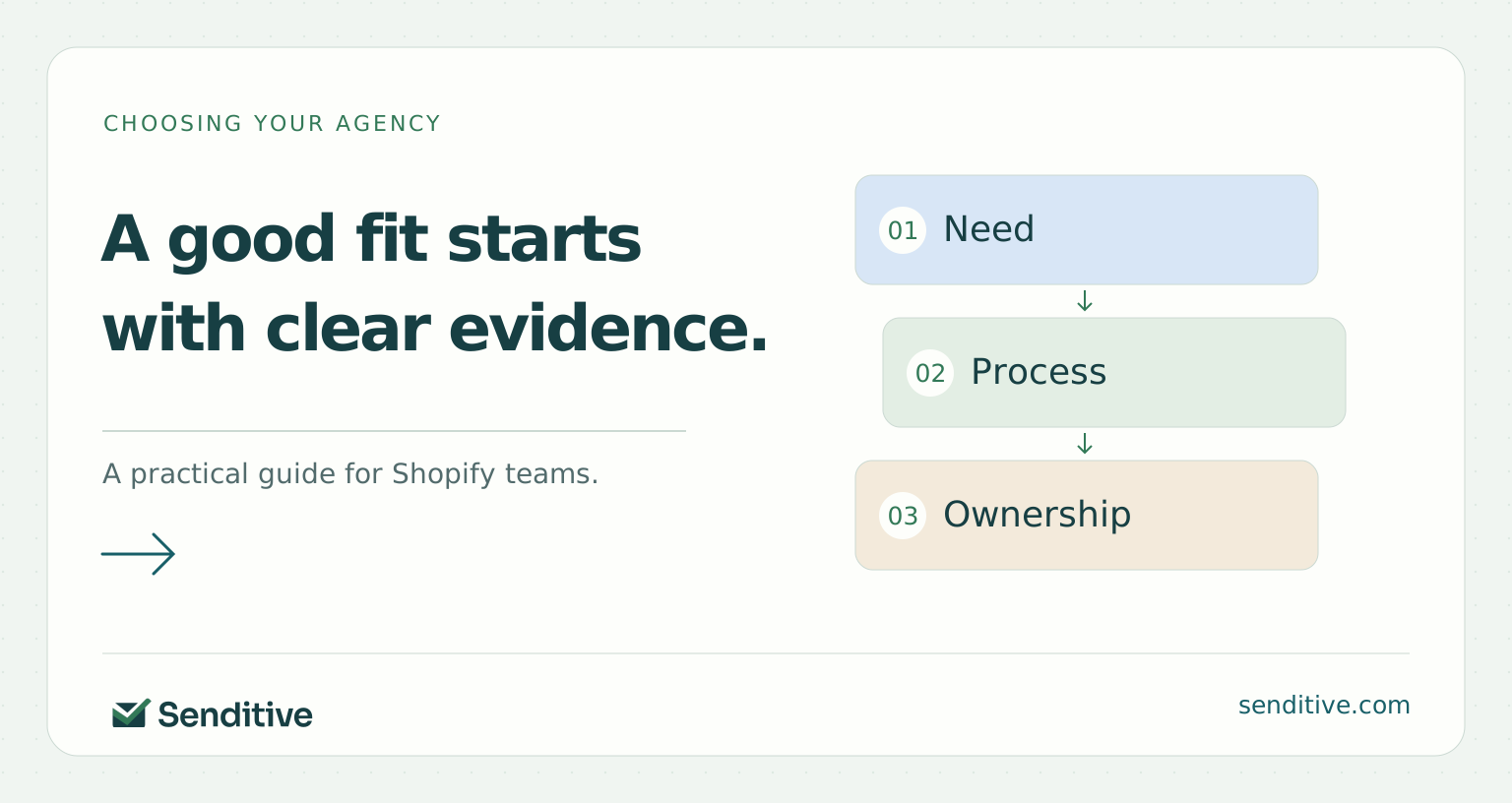
Hiring an email agency means choosing who will make decisions inside an important customer relationship. Attractive examples and a persuasive revenue chart can start the conversation, but they cannot show whether the team understands your store, can manage the work consistently, or will explain a difficult result clearly.
A useful selection process turns broad promises into evidence. You need to know what the agency will own, what your team must provide, how messages are approved, and how the account remains yours. This guide helps you compare a working partnership rather than a sales presentation, with tools for scoping the need, comparing proposals, and preparing a focused interview.
Decide what you need the agency to own
Write down the reason you are hiring before you begin interviewing. The problem may be inconsistent campaign execution, unreliable flows, weak signup offers, or a founder spending too much time managing production. Those needs require different capabilities. Asking for email marketing without naming the problem encourages proposals built around a standard package.
Separate the work into strategy, creative, production, technical checks, and ongoing management. Mark what is working, what is uncertain, and what your internal team can realistically retain. Include SMS only if it belongs in the current plan. An agency can coordinate several channels, but extra scope still needs time, budget, and appropriate operational support.
Choose a small set of outcomes for the relationship, such as dependable execution, a coherent subscriber journey, or better evidence for prioritizing improvements. Avoid turning an early discovery conversation into a demand for a guaranteed revenue result. Clear ownership and useful evidence are assessable before a contract; a promised result without the store's context is much harder to judge.
Put it into practice
Agency selection brief
Translate your need into evidence to request
Change the inputs to prepare your next decision. This tool runs locally and does not connect to your store.
 senditive.com
Ask how strategy becomes a customer journey
A credible team should connect its recommendations to the customer's decision. Ask how it would learn what a new subscriber needs before a first order, what changes after purchase, and when a campaign earns attention. Listen for questions about your products, margins, audience, purchase cycle, and existing messages.
Shopify and Klaviyo both offer automation capabilities, so the presence of a welcome or recovery flow is not by itself proof of strategic depth. Ask why the agency chooses a particular entry point, message purpose, exclusion, and exit. A useful explanation links the platform setting to the customer experience it is intended to create.
Request a walkthrough of the planning process rather than a free custom strategy. The agency can explain the questions it asks, the evidence it reviews, and how it prioritizes work without inventing a diagnosis of an account it has not examined. You are assessing whether decisions have a method and whether the team can revise them when the evidence changes.
Reference: Email welcome series; Marketing automation templates.
Evaluate the work behind the portfolio
Look beyond whether the emails resemble your preferred visual style. Ask what the message needed to achieve, what the agency produced, what information the merchant supplied, and which constraints shaped the final design. The answer should make the creative decision understandable, even when you would choose a different aesthetic.
Review copy, mobile hierarchy, offer clarity, product accuracy, and the destination after the click. Ask how the agency handles different products or customer states without sending everyone the same generic message. A beautiful email with an unclear promise or an unsuitable destination is incomplete work.
Test the operational process before committing
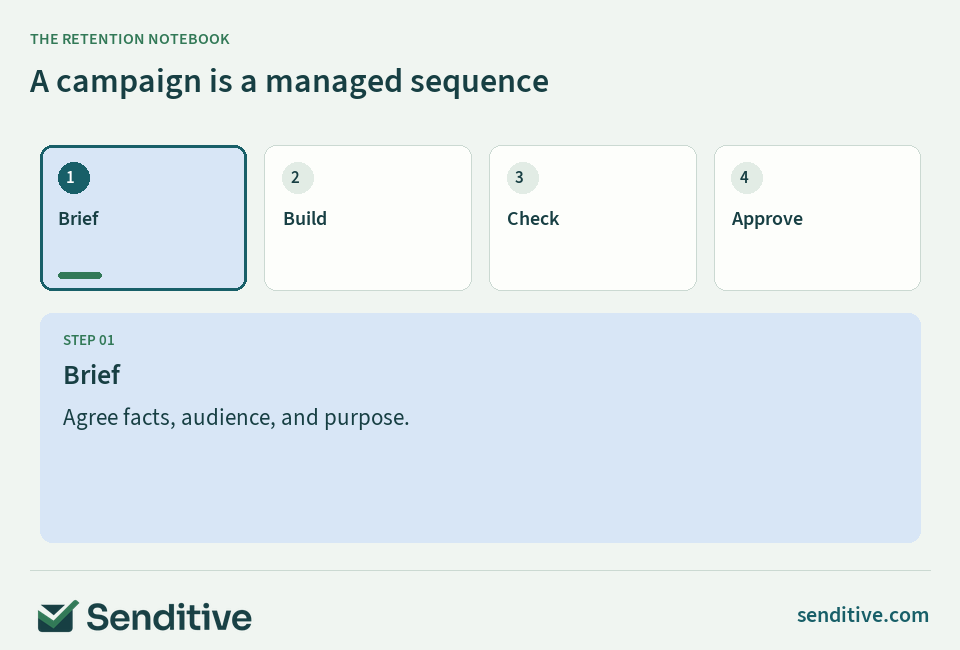
Ask a candidate to describe an ordinary campaign from brief to review. Who writes, designs, builds, checks, approves, and schedules it? What happens if product information changes or the merchant misses an approval deadline? A workable process includes dependencies and decision points, not only an attractive delivery timeline.
Automation work needs a different acceptance process from a campaign preview. In Klaviyo, Draft, Manual, and Live message statuses have different behavior. An agency should test an eligible profile's path, the rendered content, and the cases that should be skipped before calling a flow complete.
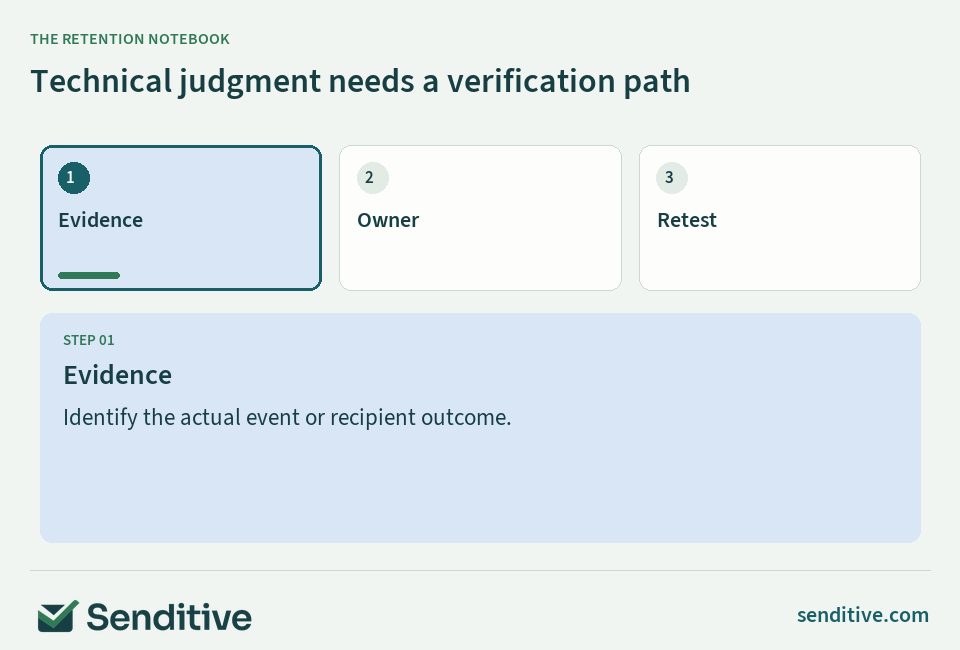
Ask how the team records those checks and responds to mistakes. You want a named owner, an escalation path, and a way to confirm the repair. No responsible process can promise that errors never occur. The stronger evidence is a system that reduces avoidable failures, notices problems, and explains what changed without leaving the merchant to investigate alone.
Reference: Flow ready to send.
Make the scope comparable across proposals
Create the same scope checklist for every candidate. Count messages within automations as well as the number of flow names. Clarify campaign volume, forms, segmentation, testing, reporting, meeting cadence, and ongoing maintenance. A proposal for three short flows is different from three journeys with several branches and coordinated channel rules.
Ask what is excluded and how extra work is priced. Common boundaries include migration, custom integrations, extensive localization, urgent campaigns, new templates, and developer tasks. An exclusion is not automatically a weakness; an unclear exclusion is a comparison problem. You need to know which team will own the omitted work.
Record the merchant's obligations beside the agency's deliverables. Product facts, commercial offers, inventory decisions, and final approvals may remain with you. Use the comparison tool to mark included, excluded, or unclear items and to list the next question. It deliberately does not produce a pretend quality score from a collection of checkboxes.
A free consultation can help you define that brief and discuss a personalized roadmap before you compare managed-service options.
Before comparing two proposals, give each the same concrete request: maintain the existing welcome journey, prepare an agreed campaign cadence, improve the signup invitation, and report the next priority. Ask each provider to identify what is included, what needs an initial review, and what remains your responsibility. A qualified answer may contain questions and exclusions. Preserve those answers in the comparison rather than interpreting every uncertainty as a refusal. The exercise should clarify the work and the evidence needed for a quote; it should not request unpaid custom creative or confidential client information.
Put it into practice
Agency scope comparison
Surface included, excluded, and unclear work
Use the written proposal as evidence. Each row should describe the same requirement for both agencies; no quality score is inferred.
senditive.comKeep account ownership and permissions explicit
Keep the store and marketing accounts under your business's ownership. Grant named access appropriate to the work, rather than sharing a personal password or handing over the only owner login. Shopify supports collaborator access controlled by the merchant; Klaviyo documents roles with different permissions.
Ask who can change billing, manage users, create keys, edit authentication, or send messages. The required role depends on the agreed tasks. A content producer does not necessarily need the same access as the person maintaining integrations. Review access when responsibilities change and when a person leaves the agency.
Agree what remains available at the end of the engagement: templates, creative files, flow documentation, audience definitions, and reporting notes. Klaviyo supports exporting lists and segments with selected profile properties, but an export is not a substitute for preserving the meaning and lawful use of the data. A clear handoff should make the program understandable to its next owner.
Reference: User management and privileges; Collaborator accounts; Exporting lists and segments.
Examine how results are defined and discussed
Ask a candidate to explain what its revenue number represents. Which platform, attribution window, conversion event, date range, and customer group are included? Can the team distinguish platform credit from additional business impact? A chart is more useful when another person can understand the rules behind it.
Look for a reporting conversation that includes reach, customer experience, and commercial context. A higher credited figure may reflect changed settings, different audience size, more discounts, or a seasonal increase. Those explanations do not make the work worthless; they help you decide what the result actually supports.
Reference: Message attribution.
Assess technical judgment without demanding a certification contest
Relevant platform experience helps, but ask for an explanation of a real category of decision. For example, how does the team check entry and purchase exclusions in a flow? How does it determine whether a skipped message is working as intended? Good technical judgment connects configuration to observed profile activity.
Deliverability also deserves an owner. Google's guidance for personal Gmail accounts distinguishes all-sender requirements from additional bulk-sender requirements. Ask who verifies the relevant authentication and unsubscribe setup, monitors sending problems, and coordinates with your domain or technical team. A platform logo in a portfolio does not answer those operational questions.
Do not expect the agency to replace every specialist. It may need your developer, legal adviser, support team, or platform support for a specific issue. The useful distinction is whether it can identify the dependency and manage the next action. Overconfident answers to every technical or legal question can be less useful than clear boundaries and appropriate escalation.
Reference: Email sender guidelines; Flow triggers and filters.
Discuss the commercial relationship and the exit
Read the agreement alongside the scope. Confirm setup fees, recurring fees, platform costs, billing dates, contract length, notice, and the treatment of work already in progress. Ask how the agency approves additional work and what happens to access and assets when the engagement ends.
Make response expectations practical. Define normal communication channels, meeting cadence, and how urgent issues are raised. A small store and an international brand may need different coverage. Avoid assuming that a regular retainer includes unlimited availability or same-day work without a written agreement.
Consider a clearly scoped initial phase when substantial uncertainty remains. The objective is to produce a reviewable baseline, complete defined work, and judge how the teams collaborate. It should have acceptance checks and a next decision. An initial phase is useful when it answers real questions; it should not become an indefinite series of vague discovery activities.
Put it into practice
Agency interview agenda
Prepare questions matched to the working relationship
Change the inputs to prepare your next decision. This tool runs locally and does not connect to your store.
senditive.comChoose the best fit and record the first priorities
After the interviews, compare evidence against the need you wrote at the beginning. Identify which candidate can own the required work, which dependencies remain, and which uncertainties need a direct answer. Do not let the longest feature list replace the question of whether your team can work effectively with the people involved.
Record the first priorities, the accountable owners, and the conditions for launching. Give the agency accurate brand and product material, confirm permissions, and agree how approvals will work. A well-chosen partner still needs a usable onboarding process to turn its capabilities into dependable work for your store.
Review the relationship against both execution and learning. Are commitments clear, work checked, questions answered, and decisions better supported? A free consultation with Senditive can help you discuss the managed strategy, copy, design, builds, testing, maintenance, and reporting your program needs. Choose the partnership you can understand and evaluate, rather than the promise that is hardest to verify.
Your questions, answered
Should I choose an agency that only works with Shopify?
Shopify familiarity is useful when it matches your integrations and workflows. Ask how the team verifies subscriber sources, product data, purchase events, and native automations. Relevant evidence and sound judgment matter more than a specialization label by itself.
Should an agency guarantee email revenue?
A guarantee needs careful examination of the definition, assumptions, exclusions, and remedy. Traffic, product economics, customer demand, and attribution affect reported revenue. Prefer clear scope, accountable execution, and a method for evaluating outcomes over an unexplained revenue promise.
What should happen to my account if I stop working with an agency?
Your business should retain ownership and the agreed assets and documentation. Remove unnecessary access, preserve important records, and assign the next operator. Confirm handoff terms before signing so the transition does not depend on an informal promise.
How many agencies should I interview?
Interview enough candidates to understand meaningful differences, while giving each the same brief. A small, well-prepared shortlist is often more useful than collecting many incomparable proposals. Resolve unclear scope and ownership before treating price as the deciding factor.
Choose your next improvement
The strongest agency choice combines clear scope, thoughtful decisions, dependable operations, and a relationship your team can sustain. Make those qualities visible before signing.
Sources and further reading
- Klaviyo: Email welcome series
- Shopify: Marketing automation templates
- Klaviyo: Flow ready to send
- Klaviyo: User management and privileges
- Shopify: Collaborator accounts
- Klaviyo: Exporting lists and segments
- Klaviyo: Message attribution
- Google: Email sender guidelines
- Klaviyo: Flow triggers and filters
- Klaviyo: Getting started with Shopify