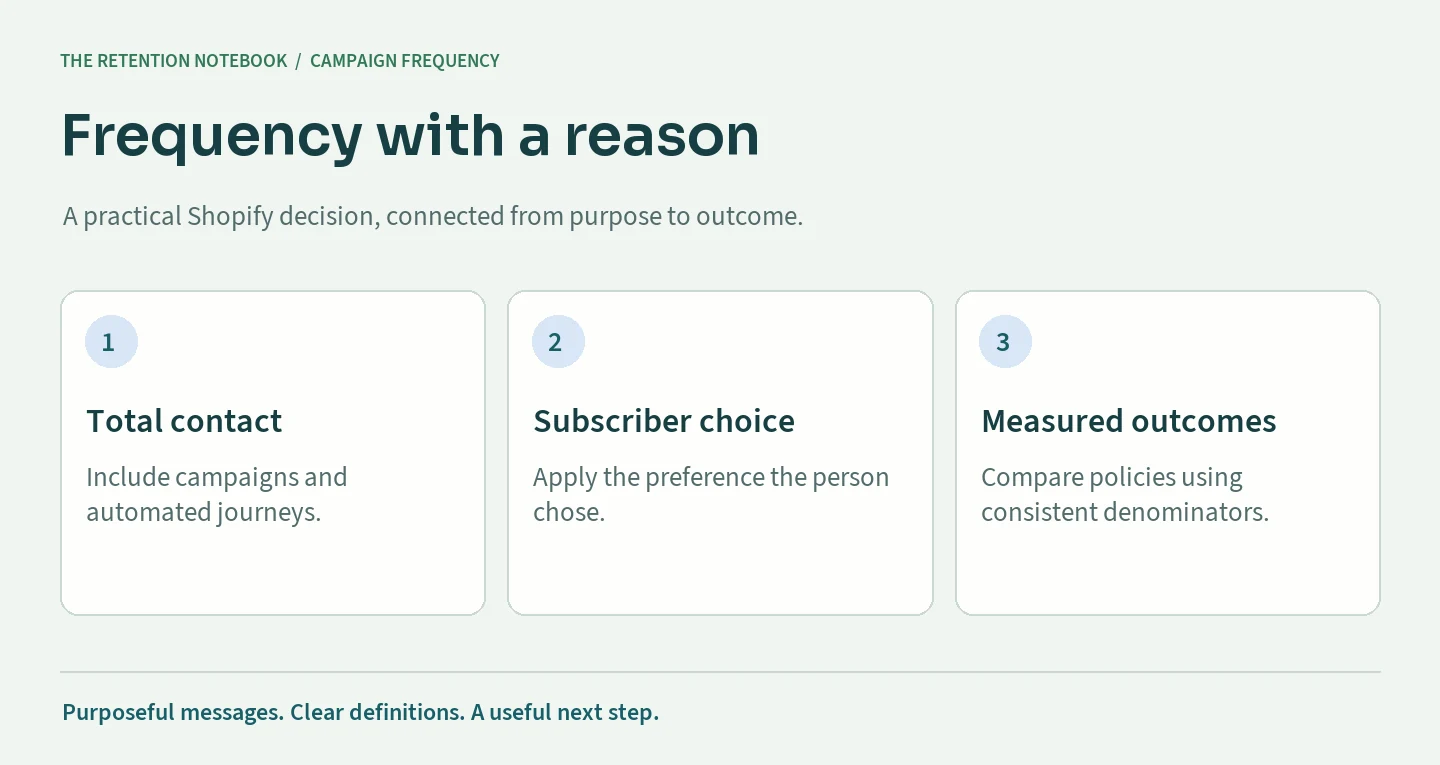
The right email frequency is a decision about customer usefulness, permission, and total contact pressure. It is not a universal number of campaigns per week. A subscriber receiving a welcome sequence, a checkout reminder, and several campaigns experiences all of those messages, even when separate teams report on them.
Increasing volume can expose a useful message to more opportunities, but it can also repeat an unwanted conversation or reach people whose interest has faded. Reducing volume can protect attention, yet an arbitrary cut can remove messages that subscribers actively want. The answer needs evidence about the people receiving the email and the business outcome you want to improve.
This guide focuses on choosing and testing a sending policy. It does not prescribe a universal benchmark or suggest that the largest campaign count wins. Use the tools to estimate total contact, compare frequency groups, and translate subscriber preferences into a practical policy you can maintain.
Count the whole customer experience before changing campaigns
Begin with the number of marketing messages an individual can receive over a defined period. Include welcome, cart and checkout recovery, replenishment, winback, and campaigns. A store sending two campaigns a week may still contact a particular new shopper much more often because several journeys become relevant at once.
Review real recipient timelines rather than adding the maximum length of every flow. Most customers will not qualify for every automation. Choose representative paths, such as a new subscriber who browses, a recent buyer, and a long-standing subscriber. Record the messages received, skipped, and scheduled, with their purpose and channel.
Keep message types distinct. Necessary order or service communication is not interchangeable with a discretionary promotion. An email subscription does not establish SMS permission, and an SMS quiet-hours policy does not define email frequency. Coordinate the experience across channels while retaining each channel's eligibility, timing rules, and reason to exist.
Choose a consistent reporting period for your review. A week can help reveal concentrated pressure; a longer window can show uneven contact and changing behavior. Capture both the average and the busiest paths. An average that looks modest can hide a small group receiving nearly every campaign and several automated messages together.
Reference: Klaviyo: Understanding Smart Sending.
Separate subscriber permission from subscriber interest
Permission is the starting requirement, not evidence that every message will remain welcome indefinitely. Review actual email status and suppression conditions before forming a frequency segment. Do not reactivate an unsubscribed person simply because they purchased recently or because a sales target requires a larger audience.
Then examine interest using several relevant signals. Recent clicks, product activity, purchases, replies, and a stated preference may help describe the relationship. Consider what each signal actually means for your product. A customer who purchased a durable item may need less promotional contact but still value useful ownership guidance.
Treat opens carefully. Privacy-related email behavior can make an apparent open a poor measure of attention. Avoid building the entire frequency policy around a single open-based threshold. Document the signals available to your store and use direct choices or meaningful actions where they provide a clearer picture.
Keep uncertainty visible. Someone can be eligible but have little recent observable activity. That is a reason for a deliberate lower-pressure or re-engagement approach, not proof that the person dislikes your brand. Describe the segment as a working definition, and revisit it when the tracking setup, buying cycle, or subscriber source changes.
Reference: Klaviyo: Sending schedules based on engagement.
Put the guide into practice
Total contact pressure calculator
Count campaigns and received flow messages together.
Enter messages actually received by one representative person over the same number of days. This estimates contact rate, not an optimal cadence.
Enter the facts, then review the result
- Complete the inputs to review this decision using your own store facts.
Discuss the next decision in a free consultation.
 senditive.com
Give audiences different contact policies for different needs
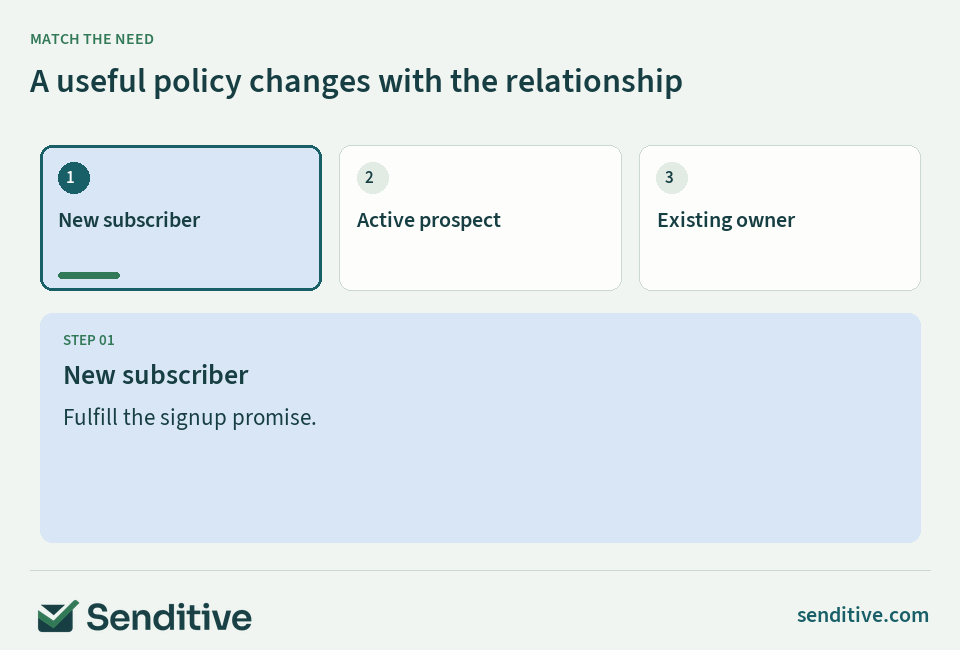
Define a small number of understandable groups. A new subscriber, an active prospect, a recent customer, and a quieter subscriber can have different reasons for receiving email. Too many overlapping tiers create a policy the team cannot reliably explain, implement, or test.
Write each group's purpose before assigning its cadence. New subscribers may need the promised resource and an introduction. Existing owners may need care guidance or relevant complements. Active prospects may benefit from product comparisons. Lower-interest subscribers may need fewer messages and a clear way to express what they want.
Decide how someone moves between groups. A purchase, preference change, or period without meaningful activity may alter the policy. Test the transition so a profile does not qualify for both a high-frequency and a low-frequency audience at the same time. When rules conflict, define which preference or state takes precedence.
Start with a policy the team can operate consistently. You can refine a small number of groups once their behavior is visible. A complicated segmentation model is not automatically more respectful or more profitable. It is useful only if the data supports it and the sending process actually applies the intended rules.
Reference: Klaviyo: Sending schedules based on engagement.
Make a frequency preference an operational promise
If you offer a choice such as weekly highlights or fewer updates, define what that choice includes. Explain whether welcome messages, product-use guidance, or other categories follow separate rules. A preference label should describe a recognizable experience, rather than a setting whose meaning changes with each campaign.
In Klaviyo, a preference-page choice can be stored as a profile property and used in frequency segments. The property itself does not create a universal sending restriction. Every relevant campaign and flow must apply the policy you designed, and the team needs a clear treatment for missing or older preference values.
Keep unsubscribe straightforward. A person should not need to negotiate a frequency preference before leaving marketing email. Review the preferences page on mobile and test how a change appears on the profile. Verify that it affects future audience selection, including campaigns already prepared or scheduled under a previous audience snapshot.
Choose a conservative default for an unknown preference and explain it internally. Do not silently convert a request for monthly highlights into permission for every sale reminder. Periodically audit the send history of profiles in each preference group. The point is to honor an actual choice, not merely to collect another property.
Reference: Klaviyo: Create email frequency segments.
Put the guide into practice
Subscriber preference policy guide
Turn an entered preference into a sending decision.
This planning route does not update a profile or override permission. A preference property must be applied by the actual campaign and flow rules.
Enter the facts, then review the result
- Complete the inputs to review this decision using your own store facts.
Discuss the next decision in a free consultation.
senditive.comImprove the reason to send before increasing the count
Inspect the content that would occupy the extra slots. If the plan adds another version of the same promotion to the same people, the experiment tests repetition as much as frequency. Decide whether each additional message answers a distinct buying question or reaches a different relevant audience.
Use the customer's task to assess usefulness. A comparison, a product-use answer, and a genuine availability update can play different roles. A changed subject line does not create a new role. Make the proposed content concrete enough that the team can judge whether it deserves another place in the customer's inbox.
Check the destination and offer economics as well. More clicks to an unclear page may create little value, and more discounted orders may not produce more contribution. Increasing frequency should not become a way to avoid fixing product information, delivery uncertainty, stock availability, or a weak first-purchase experience.
Keep a lower-frequency version of the plan visible. If a send had to be removed, which customer need would become less well served? This question helps rank campaigns by purpose. It also gives you a coherent control policy for a test, rather than treating the absence of a random email as the entire alternative.
A free consultation can connect content usefulness and capacity before extra sends are added.
Design a fair comparison between frequency policies
Define the change in advance: for example, the current campaign policy versus the same core policy with an additional useful message. Choose an eligible audience and assign comparable groups before the period begins. A random allocation can support a causal comparison when implemented correctly; existing high- and low-engagement segments are not equivalent controls.
Keep the rest of the experience as consistent as practical. Document offers, automated messages, audience exclusions, product availability, and other marketing exposure. If one group receives a stronger discount or different product range, you cannot attribute the observed difference solely to email frequency.
Choose the follow-up period before seeing the result. Allow time for the buying decision and the relevant customer behavior to mature. Do not call a winner because the first day looks favorable, or extend the test only when the preferred outcome has not appeared. Record changes that would make the comparison invalid.
Decide the guardrails and stopping conditions with the team. Complaints, delivery deterioration, customer-support concerns, or a permission error may justify stopping independently of revenue. A modest audience may produce an inconclusive commercial result. Treat that as uncertainty to manage, rather than forcing a precise optimal frequency from insufficient information.
Reference: Klaviyo: A/B test flow branches.
Compare outcomes per assigned person, not only per send
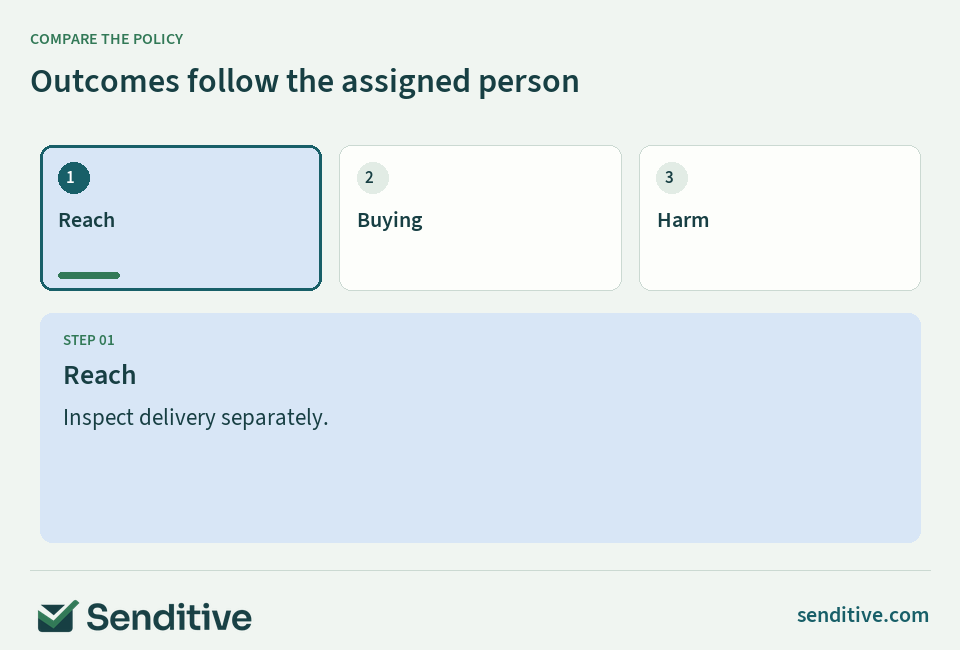
A higher-frequency group receives more chances to click and purchase after an email. That makes per-message results a limited way to judge the overall policy. Compare total outcomes per person assigned to each policy over the same period, including people who did not receive every intended message.
Use measures that fit the objective. These may include purchasers per thousand assigned people, net revenue per assigned person, contribution after relevant costs, and unsubscribe or complaint rates. Count each purchaser once when the metric is purchaser rate; do not mix order count and customer count under the same label.
Keep denominators explicit. Assigned, eligible, sent, and delivered populations answer different questions. Delivery coverage is useful operational evidence, but comparing only delivered recipients can distort an experiment if the policy itself affects delivery. Preserve the original group assignment and report delivery differences separately.
Review costs and downstream consequences. Additional creative work, sending charges, discounts, and future audience loss can change the business decision. The comparison tool here describes the inputs you enter; it does not calculate statistical confidence or prove a long-term effect. Use an appropriate experiment analysis before making a stronger causal claim.
Put the guide into practice
Frequency policy comparison
Compare buying and unsubscribe outcomes per assigned person.
Use comparable assigned groups and the same follow-up window. Counts refer to unique people. No significance or causal certainty is calculated.
Enter the facts, then review the result
- Complete the inputs to review this decision using your own store facts.
Discuss the next decision in a free consultation.
senditive.comUse contact-pressure settings as safeguards with clear limits
Klaviyo Smart Sending checks recent contact within the configured channel window. Its documentation explains that skipped messages are not automatically rescheduled. Review the settings that actually apply to each campaign or flow action. A skip count can explain reach, but it cannot tell you whether the skipped message was the more important conversation.
Do not confuse send-time optimization with frequency management. Choosing an hour changes timing; deciding which messages a person should receive changes the contact policy. The two decisions interact, but they need separate goals and evidence. An optimized hour does not make an irrelevant additional promotion useful.
Set priorities for overlapping journeys. A purchase should change first-order messaging, and a checkout action may make an earlier browse reminder outdated. Use the appropriate event and profile conditions as well as any contact-pressure safeguard. Timing alone cannot keep every message aligned with the customer's current state.
Audit the actual skipped and received paths after implementation. A lower delivered count may be the intended protection working, a wrong audience rule, or a configuration error. Read recipient activity before changing the policy. Repeatedly disabling safeguards to hit a planned send count defeats the purpose of defining a frequency policy in the first place.
Reference: Klaviyo: Understanding Smart Sending.
Introduce a change gradually and review customer consequences
Choose a bounded rollout and record the starting policy. A gradual operational change is easier to monitor than expanding every segment at once, although a rollout by itself is not a randomized experiment. Keep the distinction clear when reporting what the result can establish.
Monitor both intended outcomes and harm signals. Review unsubscribes, complaints, bounces, replies, support themes, and provider-level patterns where available. Look for concentrated problems in a particular signup source or customer group rather than relying only on an account-wide average that can conceal the affected audience.
Give someone authority to pause the change. The stopping rule should specify the evidence that requires investigation and the person responsible for the response. Do not let a commercially promising early result override a permission failure or a clear customer-experience problem. Repair the issue before expanding the policy further.
Allow the team to reverse a change without treating it as a failed project. A useful test can show that the existing cadence is sufficient, that one audience needs less contact, or that the extra message needs a better purpose. Those findings can improve the program even when the final campaign count does not increase.
Reference: Klaviyo: Sending schedules based on engagement.
Maintain a policy that changes when the relationship changes
Document the current frequency rules in a place the campaign and automation owners both use. Include segment definitions, stated preferences, priority rules, contact-pressure settings, and the last review date. The policy should survive a staff change or a busy launch period without depending on one person's memory.
Recheck it after meaningful changes to the store. A new product category, a longer replenishment cycle, a different signup source, or a major automation rebuild can alter the customer experience. The cadence that worked for an established customer group may not fit a new group with different expectations or buying needs.
Use a recurring review to choose the next question, not to restart the entire policy. Investigate unexpected contact, update weak content, and verify that preferences are being honored. Retain the original test definitions and results so the team can distinguish a genuine policy change from a temporary seasonal exception.
The practical goal is a useful, sustainable relationship with subscribers. Set the campaign count after deciding what the customer needs, what they chose, and what the evidence supports. A frequency policy earns its place by making those decisions clearer, not by producing a universal number that every Shopify brand is expected to copy.
Discuss how the policy should evolve with your store in a free consultation.
Reference: Klaviyo: Create email frequency segments.
Your questions, answered
Is daily email always too much?
No universal count establishes the right policy. Relevance, audience expectations, stated choices and total automated contact matter. A daily schedule for one group does not justify the same cadence for every eligible subscriber.
Does Smart Sending choose the best frequency?
It checks recent contact within the configured channel window. It does not decide which content is useful or establish a customer preference, and a skipped message is not automatically rescheduled.
Should frequency segments use opens alone?
Avoid relying on that single signal. Privacy-related opens can obscure attention. Use appropriate meaningful behavior, relationship context and direct preferences, while recording what each segment definition can establish.
How do I compare a higher-frequency test fairly?
Assign comparable eligible groups before exposure, define the differing policy and use the same complete observation period. Review per-assigned-person business outcomes and unsubscribe or complaint guardrails. Statistical confidence requires a suitable separate analysis.
Choose one useful next decision
Start with the customer decision and the facts your store can verify. Keep the definition, owner and review period visible so the next change can be understood and maintained.