
Your email dashboard shows revenue. Your campaign report shows clicks. Your team still cannot agree whether to rebuild the welcome series, change the popup, send more campaigns, or clean the list. An audit should make that decision easier.
A Shopify email marketing audit is a structured review of how your program collects subscribers, uses customer data, sends relevant messages, and measures results. Its most useful output is a short, evidence-backed order of work.
That requires looking beyond individual emails. A weak campaign can be the visible symptom of a targeting problem. A welcome flow can look ineffective because the wrong subscribers enter it. Better creative will struggle to solve a broken connection.
Use these ten checks to examine the whole program without turning the review into an endless rebuild. Capture what you know, label what needs investigation, and assign a realistic next action.
Define the business question and audit boundary
Begin with the decision the audit needs to support. “Improve email” is too broad. A better question is why new subscribers rarely become customers, why repeat purchases have slowed, or why the team cannot maintain a dependable campaign schedule.
Choose a review period with enough activity to be useful, and record what makes it unusual. A promotion, stock shortage, acquisition spike, or product launch can distort an otherwise reasonable comparison. Keep the underlying dates and filters with your notes.
Create an inventory of the systems involved: Shopify, your email platform, form apps, SMS provider, subscription tools, and any customer-support connection. Name the person who can verify each system. Separate the audit’s questions from the changes you may eventually make.
Set a stopping point too. You are deciding what deserves attention and why. A complete redesign of every template is a separate project. Finish this first step with one main goal, a baseline, a scope, and a decision owner.
If your team is weighing several directions, book a free consultation with Senditive to discuss your priorities and a personalized roadmap for the program.
Verify the customer data and permission behind the messages
Follow a small set of real journeys through the systems: a new subscriber, a first-time buyer, a returning customer, and someone who has opted out. Use accounts you are authorized to inspect and avoid collecting more personal information than the review needs.
For each journey, check the source event, time, product details, channel permission, destination list, and resulting eligibility. A customer profile existing in a platform does not by itself answer whether you should send promotional email or SMS to that person.
Review sync direction rather than assuming everything travels both ways. Klaviyo documents which data can sync back to Shopify and notes that Klaviyo suppression does not update Shopify consent. It also explains that deleting a profile in one system does not delete it in the other.
Record a mismatch as a specific finding: which field differs, in which system, since when, and which messages depend on it. Preserve consent records while the responsible owner investigates. An audit should reveal uncertain data, rather than disguise uncertainty with a new segment.
Confirm market and channel requirements for your actual audience. Shopify’s guidance makes clear that automated consent settings do not replace checking the obligations that apply to the business.
Reference: Klaviyo–Shopify data sync; Shopify consent collection.
Check delivery foundations before expanding sending
Separate three questions: was a message eligible to send, did the receiving server accept it, and where did it reach the recipient? A good answer to one does not prove the others. Start with the pattern of the problem.
Review sending-domain authentication, complaint trends, bounces, and performance by inbox provider. Google’s Gmail sender guidelines include authentication and unsubscribe requirements, with additional requirements for bulk senders. Check the current scope that applies to your sending rather than borrowing a generic setup checklist.
Look for a change concentrated in one provider, audience, campaign, or period. Klaviyo’s bounce reporting can show categories and provider-level patterns. That is more useful than treating every failed delivery as the same issue.
If a current problem is affecting recipients, give its investigation an owner before increasing reach or frequency. Avoid making broad, irreversible list changes merely because an aggregate metric looks uncomfortable.
Document the symptom, affected sends, recent changes, and validation needed. Passing authentication is a foundation; it does not guarantee inbox placement. The audit’s job is to narrow the investigation so the right person can act.
Reference: Gmail sender guidelines; Klaviyo bounce reporting.
Put the audit into practice
Program audit check
Find the next area to verify
Verify data and permission first
Trace an authorized subscriber and customer journey. Record the source event, consent status, destination, and any mismatch before changing sending rules.
Read the matching audit guidanceThis is a review sequence, not a performance score. Your selections stay on this page.
 senditive.com
Trace signup through confirmation and the first useful email
Test the entire entry path, beginning on a page a shopper actually visits. Read the signup promise, complete the form, follow any required confirmation, and check the first welcome message. Record any point where the experience stops matching the promise.
Review who sees the form and who should be excluded. Then compare form views, submissions, eligible subscribers, and first orders. Klaviyo distinguishes total-event measures in its form overview from unique measures in A/B reporting, so confirm the denominator before comparing results.
A large list of submissions is less useful if confirmation is confusing or the promised offer never arrives. Equally, a lower submission rate can reflect a different audience or display rule. Identify the missing connection before prescribing a stronger discount.
Keep the finding at program level: the audience, entry point, promise, handoff, and evidence. Detailed mobile layout or offer testing can become a focused follow-up project once you know that capture is the bottleneck.
For help deciding whether forms or welcome messages deserve attention first, book a free consultation with Senditive to discuss the customer journey and the next useful improvement.
Reference: Klaviyo form analytics; Klaviyo welcome entry.
Audit lifecycle coverage and actual flow eligibility
Build a coverage map of the moments your program intends to serve: signup, product interest, an unfinished purchase, a completed order, product use, and a reasonable opportunity to return. Mark each as working, missing, or unverified.
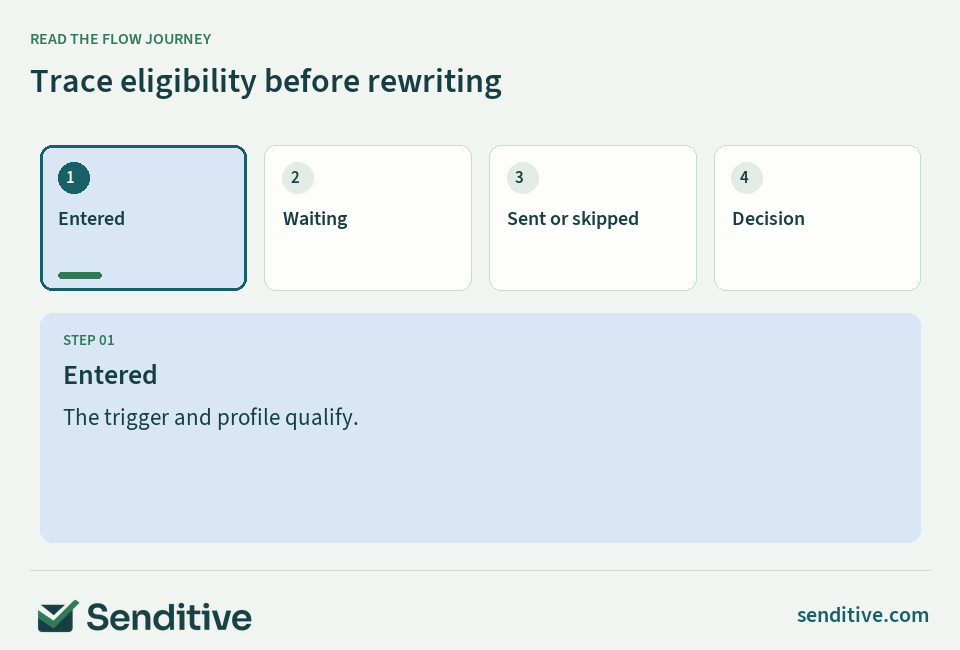
A live label is not enough. Review whether the right people enter, what happens when their situation changes, and why messages are skipped. Klaviyo’s flow analytics includes recipient activity and skip information; flow filters can be checked again before individual sends.
Compare opportunity and reach before deciding what to rebuild. A flow with little eligible traffic might be functioning normally. A high-intent journey with a verified entry problem can deserve attention even when its current attributed revenue is small.
Inspect a few representative customer paths instead of reading every message in isolation. What happens if someone buys during welcome? What happens after checkout begins? Can an order trigger competing communications from different systems?
The audit should identify coverage gaps and unreliable logic, with a test that proves the issue is resolved. It should not automatically prescribe a fixed number of flows, messages, or days for every product category.
Reference: Klaviyo flow analytics.
Review campaign purpose, audience, and total contact pressure
Choose campaigns that represent how the program really operates: a promotion, a product announcement, an educational message, and a routine send. For each, record the intended audience, commercial purpose, exclusion rules, and next action.
Look at the messages a person could receive across campaigns, flows, and SMS. The calendar may look restrained while a shopper experiences several overlapping touches. Conversely, a long gap may leave interested subscribers without the useful communication they expected.
Evaluate the content mix against the buying journey. A brand that needs product education may be relying almost entirely on discounts. A replenishable product may lack timely reorder support while the team keeps producing unrelated campaigns.
Use opens cautiously. Klaviyo explains that Apple Mail Privacy Protection can generate opens through tracking-pixel prefetching, so those opens cannot reliably distinguish human interest. Look at delivery, credible clicks, purchasing behavior, unsubscribes, and the purpose of the send together.
Review list-maintenance policy with the same care. Klaviyo describes sunset audiences using sustained inactivity across several signals. A low open rate alone is a weak basis for removing a customer who is still buying or visiting.
Reference: Klaviyo MPP reporting; Klaviyo sunset guidance.
Put the audit into practice
Issue priority planner
Rank findings with owners and evidence
Replace the starter tasks with your findings. Rank dependencies first, then customer consequence, then smaller effort. Evidence determines whether to validate or act.
Current work order
The ranking uses your inputs. It does not estimate revenue or replace an owner’s judgment about risk and dependencies.
senditive.comInspect the experience after the click and after the purchase
Open the links in your most important messages on a phone. Check the intended product, variant, price, availability, offer conditions, and checkout route. An email can communicate clearly while its destination makes the next step difficult.
Next, review what happens when a customer places an order. Separate expected order and shipping information from product education and promotional follow-up. Identify which system owns each message so the same event does not create confusing duplicates.
Ask whether the communication suits the customer’s current situation. A delayed delivery, open support issue, cancellation, or refund may change what is appropriate. Verify whether those states reach the marketing system and who can maintain the connection.
Do not assume the marketing team controls fulfillment or support policy. The audit should make those dependencies visible and name the team that can resolve them. A useful finding might be an unowned handoff, rather than a missing email.
 senditive.com
Reconcile reporting before judging performance
Write down each metric’s definition, source, date range, attribution setting, currency, and treatment of discounts or reversals. Two reports can use the same label while answering different questions. Resolve those differences before deciding which channel improved.
Shopify’s marketing reports support several attribution models. Its documentation explains that an any-click model can assign full credit to multiple channels, while other models allocate credit differently. Platform-attributed revenue therefore needs context before it becomes a performance claim.
Watch for reporting changes too. Shopify notes that its Performance by marketing channel report expanded coverage in September 2026. A comparison crossing a definition change can show movement that partly reflects the report itself.
Combine message-level evidence with business outcomes: first orders from new subscribers, repeat purchasing over a suitable period, order value, and costs relevant to the decision. Read returning-customer counts alongside percentages when acquisition is changing quickly.
Use attribution to understand reported credit, and reserve causal language for evidence that supports it. If the audit cannot establish additional revenue, say what it can establish instead. An honest measurement gap is an actionable finding.
Reference: Shopify marketing reports.
Rank findings by consequence, evidence, effort, and dependency
Write findings as decisions someone can act on. “Welcome needs work” is vague. “The signup promise is not delivered to eligible new subscribers; verify the list-to-flow connection” identifies a failure and a next investigation.
First separate verified operational blockers from possible improvements. Permission uncertainty, broken events, and failed essential handoffs can prevent other work from being meaningful. Give suspected problems a validation task rather than treating them as proven facts.
Then compare the customers affected, the importance of that moment, the evidence, and the effort. Describe impact in business terms such as purchase completion or customer understanding. Avoid inventing a revenue estimate to make the list look precise.
Name dependencies before ranking by ease. A copy change might be quick, but it cannot solve a missing event. Assign one accountable owner, the supporting teams, a completion check, and a review date. Keep a separate place for worthwhile ideas that cannot fit the current plan.
If priorities still compete, use a free consultation with Senditive to discuss which work belongs first and how a personalized roadmap could fit your team’s capacity.
Turn the audit into a manageable 30-day plan
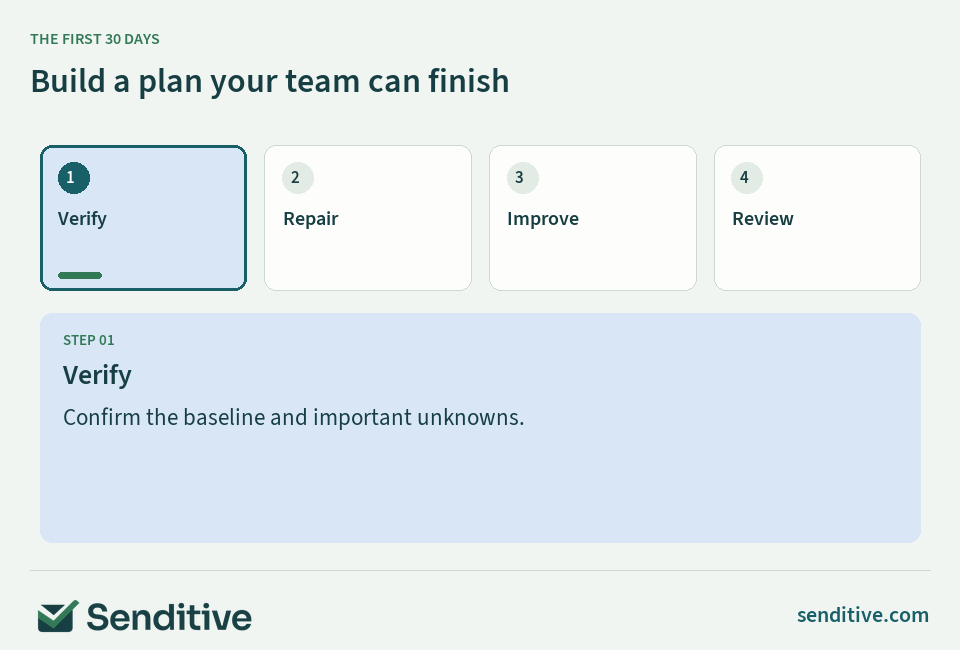
Choose a small set of commitments your team can finish. Start by confirming the baseline and resolving the most important unknowns. Move into repairs when the cause is clear, then use the remaining capacity for one focused improvement.
An action is complete when its acceptance check passes, not when someone marks a ticket done. For a handoff repair, follow the relevant test journey. For a reporting fix, reproduce the same definition in the next review. For a campaign process change, verify that ownership and approvals actually work.
Keep the plan proportional to capacity. A founder with limited weekly time needs a narrower sequence than a team with design and implementation support. Keep unresolved dependencies visible rather than distributing more simultaneous tasks.
Record what changed, who approved it, and what you will monitor. Some business outcomes need longer than a month to mature, especially for slow purchase cycles. The first 30 days can establish a working system and a credible learning plan.
Finish with a short review: what was verified, what was fixed, what remains uncertain, and what the next decision requires. That makes the audit a reusable management tool instead of a document the team never reopens.
Put the audit into practice
30-day action plan
Turn a bottleneck into owned weekly work
Choose the capacity you actually have. Validation and dependencies may change the timing.
Your action plan
Discuss your store’s priorities and a personalized roadmap in a free consultation with Senditive.
senditive.comYour questions, answered
What should a Shopify email marketing audit include?
Review the goal and baseline, data and permission, delivery foundations, signup-to-welcome handoff, lifecycle coverage, campaigns, customer experience, and reporting. Finish with ranked findings that have owners and acceptance checks. The output should explain what to fix first and what still needs validation.
How often should a Shopify store audit its email program?
Use a recurring review rhythm that fits the program, and revisit the relevant areas after major changes such as a migration, new form app, rebrand, catalog shift, or delivery issue. A full audit and routine monitoring are different activities; neither needs an arbitrary universal interval.
Should I rebuild every flow after an audit?
No. Review working coverage and actual eligibility first. Keep what serves the customer, repair verified failures, and prioritize deeper optimization where the evidence and opportunity justify it. Flow analytics and recipient activity can help separate a low-volume journey from a broken one.
Can attributed email revenue prove that the program is profitable?
It can show revenue credited under a platform’s rules. Profit also depends on discounts, product and sending costs, returns, and service costs. Additional sales require a separate causal question. Reconcile definitions before using a reported revenue share to justify a larger investment.
Choose your next improvement
A strong Shopify email marketing audit makes the next decision clearer. Follow the customer journey, verify the evidence, and repair foundational problems before expanding the program. Give each priority an owner, an acceptance check, and room in the team’s actual schedule.
Sources and further reading
- Shopify Help Center: Marketing reports
- Klaviyo: How to sync data from Klaviyo to Shopify
- Shopify Help Center: Collecting customer contact information
- Google: Email sender guidelines
- Klaviyo: Understanding bounced emails
- Klaviyo: Understanding sign-up form analytics
- Klaviyo: How to create an email welcome series
- Klaviyo: Understanding flow analytics
- Klaviyo: How to configure custom reports to track Apple Mail Privacy Protection opens
- Klaviyo: How to create a sunset flow