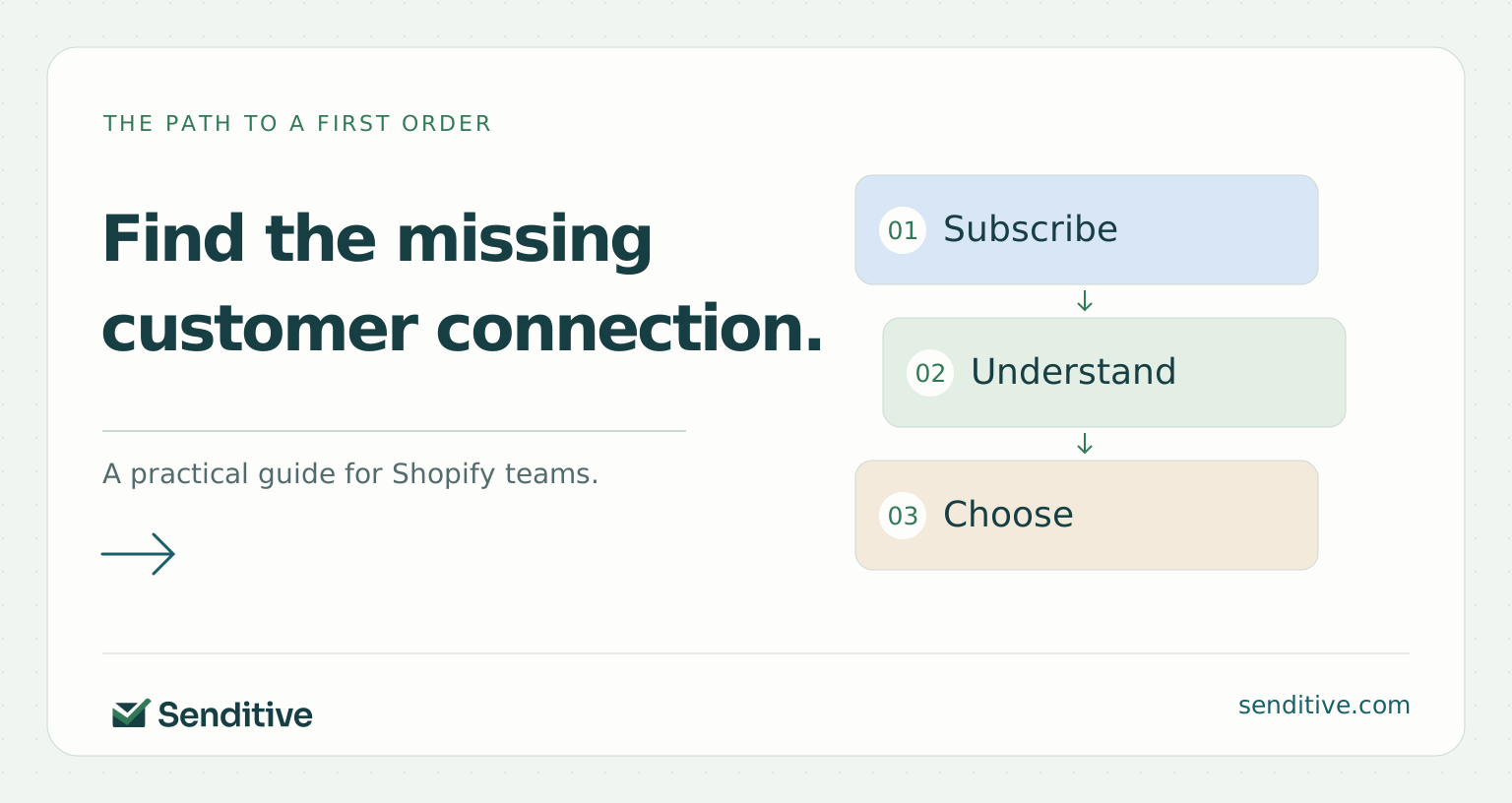
A growing subscriber list can make a quiet order report especially frustrating. The tempting response is another discount or a longer welcome sequence. Neither helps if the real problem is unconfirmed subscriptions, missing messages, an unsuitable product destination, or people who joined for a reason unrelated to buying now.
Diagnose the complete path before changing the creative. Start with a clearly defined group of new subscribers and follow what they actually experience. This guide focuses on finding the next useful investigation, rather than prescribing a universal welcome sequence or treating every nonbuyer as the same kind of prospect.
Define which subscribers and which purchase window you mean
New subscribers are not automatically new customers. Some people join after an order; others return to subscribe after browsing for weeks. Define the group you want to understand, including signup dates, source, prior-purchase status, and channel. A first-order question needs a group that had not already bought at the relevant starting point.
Choose a follow-up period that fits the product decision, and compare groups with equal time to mature. A cohort created yesterday cannot fairly be compared with one followed for several weeks. Keep recent subscribers visible as a developing group rather than classifying all of them as failed conversions.
Distinguish an observed first order from platform-attributed revenue. Attribution credits orders according to a model and window; it does not reveal every subscriber's buying path or prove that a message created the purchase. Write a simple cohort definition before opening several dashboards. That definition gives your investigation a stable denominator and prevents a reporting difference from being mistaken for a customer problem.
Reference: Message attribution.
Check whether the signup became an eligible subscription
A form submit can represent a different action from the one you have in mind. Klaviyo's analytics distinguish total form events, and a multi-step form can register a submit at the first collected channel. Some button actions can also be counted. Confirm that the people in your analysis actually became the intended email subscribers.
Trace the confirmation step where it applies. With list-based double opt-in, an unconfirmed signup is not added to the list. A profile can exist without completing that subscription path. Email and SMS also require separate channel decisions; collecting a phone number does not explain email eligibility.
Test the invitation, submit, confirmation, and expected destination with a controlled new profile. Record where the path stops instead of simply comparing form submits with welcome orders. If confirmation is the unresolved handoff, improve its clarity and reliability before rewriting the second welcome email. Preserve the appropriate consent process while you investigate; turning off a setting is not a substitute for understanding why it exists.
Reference: Double opt-in; Collecting contact information; Sign-up form analytics.
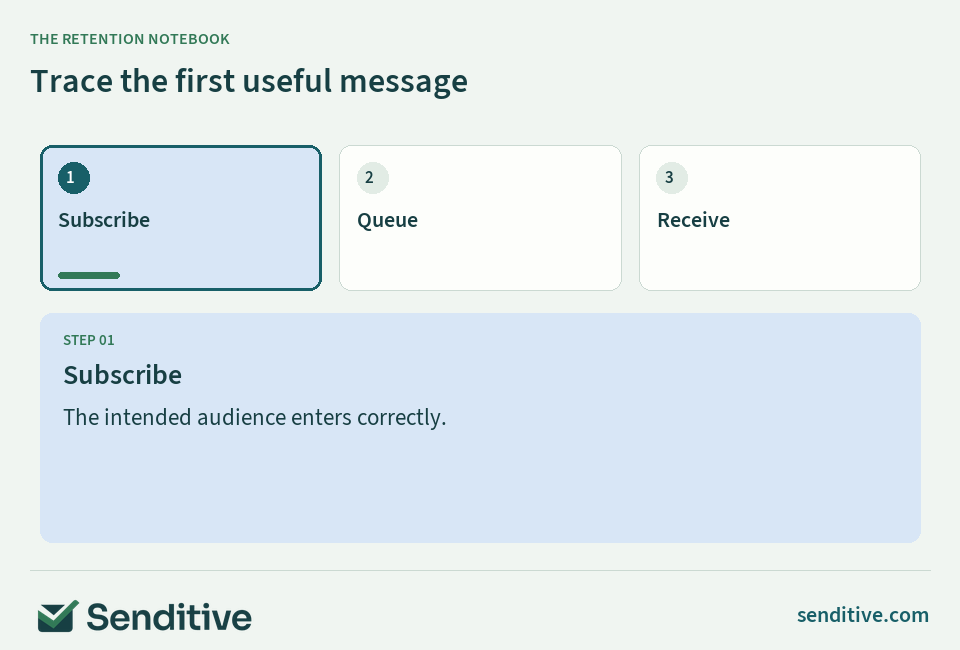
Verify that the promised first message actually arrives
A live-looking flow diagram does not prove that a particular subscriber received a message. Open representative profiles and the message's recipient activity. Check entry, delay, message status, eligibility, and the recorded outcome. Use actual recent profiles as well as a controlled test so the investigation reflects the production journey.
Skips can be intentional. A filter may exclude prior buyers or people who ordered during a delay. Smart Sending, suppression, missing channel information, or rendering problems can explain other outcomes. Read the specific reason before deciding that the flow needs rebuilding or that every skip should be eliminated.
Reference: Flow message skipped reasons; Flow ready to send.
Put it into practice
First-order funnel trace
Separate eligibility, reach, clicks, and first buyers
Use compatible unique people from one cohort and the same follow-up window. A buyer does not need to have clicked a tracked email.
 senditive.com
Compare the invitation with the promise people receive
Read the form, success message, confirmation, and welcome email together. The benefit should remain recognizable through the journey. If the signup promises a guide, deliver that guide. If it promises an offer, explain how to use it and any relevant restrictions. A subscriber should not need to reconstruct the original bargain from unrelated content.
Check the actual code or resource, not only its appearance in the editor. Confirm eligibility, expiry, product exclusions, minimum spend, currency, and where the customer can redeem it. A technically valid incentive can still create frustration if the conditions appear only after the reader has chosen a product.
Keep offer versions identifiable when testing different invitations. Klaviyo documents using distinct hidden properties for offer variations and matching follow-up. Whatever method you use, verify the correct person receives the correct promise. Do not broaden a discount because a matching problem made the original one look ineffective. First make the current offer understandable and usable; then judge whether another commercial incentive is justified.
Reference: Email welcome series; A/B testing form offers.
Make the first product decision easier
A subscriber can like a brand without knowing what to buy. Too many similar products, unclear sizing, uncertain compatibility, or an unfamiliar routine can delay an order. Look for the question that remains unanswered after the welcome message rather than assuming the reader needs more enthusiasm about the brand.
Choose a destination that helps with that decision. A curated starting collection, comparison guide, fit explanation, or clear product page can be more useful than the full catalog. Keep the message and destination aligned: if the email promises help choosing a roast, the landing page should make that choice easier.
Use support questions, search behavior, product-page questions, and actual customer feedback to identify uncertainty. Verify the facts with the team that owns the product. Then change one part of the guidance and observe whether the intended group progresses. An improvement in product exploration can support the diagnosis, but it should not be presented as a first-order result before the purchase window has matured.
A free consultation can help you connect that product decision to the signup promise and the first useful welcome message.
For a product with several variants, ask a teammate unfamiliar with the campaign to follow its main link and explain which option they would choose and why. Record the point where they need information the message or destination does not provide. Treat this as a usability observation, rather than proof that every subscriber has the same concern. Compare it with real customer questions and the relevant cohort behavior. If the evidence agrees, make the missing guidance explicit and define the next customer action you expect to become easier.
Inspect the store experience after the click
Open the email on a phone and follow its main action. Check the correct product and variant, availability, price, currency, delivery information, and the next step. A useful message can lead to an unsuitable experience if a collection changes or the advertised product is no longer available.
Review the stage where people stop, using consistent event definitions. Klaviyo's Shopify data reference explains events such as Placed Order and Checkout Started; the latter follows email entry and has a customized-checkout caveat. Do not treat every page visit, stored cart, or checkout event as the same point in the buying journey.
Ask the responsible store team to verify commercial and technical friction. Unexpected shipping costs, unclear delivery coverage, inaccessible controls, and payment problems require different remedies. Avoid diagnosing a failed payment from abandonment alone. Keep email responsible for the information and routes it can improve, while assigning checkout or fulfillment issues to the team that can actually resolve them.
Reference: Shopify data reference.
Separate low intent from an unreliable experience
Signup sources bring different reasons for joining. A visitor seeking a size guide, someone browsing a gift, and a person attracted by a broad giveaway may not have the same immediate purchase intention. Compare these sources before describing the entire list as low quality or blaming the welcome content.
Look at traffic context, campaign promise, device, market, and prior familiarity with the store. A change in acquisition mix can move the overall first-order rate even when each source performs similarly to before. Preserve useful source information without collecting unnecessary personal data, and avoid interpreting small segments as precise evidence.
Put it into practice
First-order bottleneck router
Find the earliest handoff that still needs evidence
Change the inputs to prepare your next decision. This tool runs locally and does not connect to your store.
senditive.comReview contact pressure and competing conversations
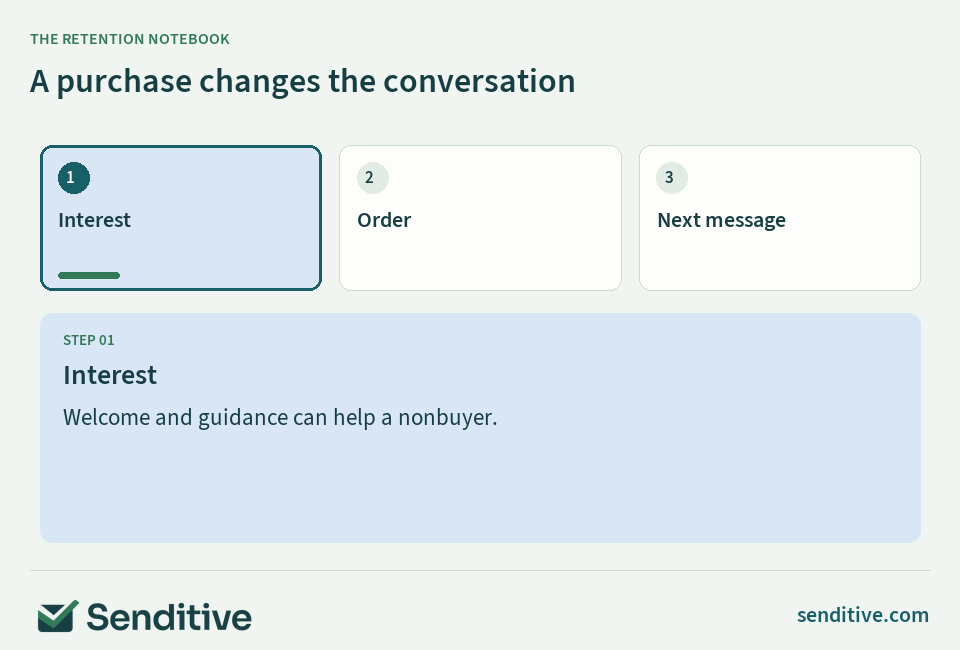
Map the messages a new subscriber could receive during the same period. A welcome sequence, recovery flow, scheduled promotion, and SMS campaign may all compete for attention. The total experience matters more than whether each individual campaign looks reasonable in isolation.
Klaviyo's Smart Sending limits recent contact within a channel, while email and SMS windows are separate. A skipped message is not automatically rescheduled. Treat that as one control, then review stage-based priorities and the message purpose. A first order should change which promotional assumptions remain appropriate.
Check relevant purchase-aware filters at the point where messages are sent. A split can record a decision earlier in the journey without accounting for a later order. Do not remove protective rules simply to increase delivery. Decide which conversation deserves priority, make the rule explicit, and test a profile that changes state during the sequence so the resulting experience matches your intention.
Reference: Smart Sending; Flow triggers and filters.
Turn the evidence into one focused test
Choose the first verified issue that blocks the journey or prevents a clear decision. Repair a broken link or missing promised resource before testing a new design. When the path works, turn a specific customer uncertainty into a hypothesis: clearer size guidance might improve progress among subscribers considering the relevant product.
Keep the tested change narrow enough to interpret. Define the audience, variant assignment, primary measure, observation period, and guardrails before reviewing results. Klaviyo's form testing guidance recommends changing one variable at a time; the same discipline helps avoid a welcome experiment that changes the offer, audience, timing, and destination simultaneously.
Use the journey test-plan tool to name the owner and acceptance check. A completed repair proves the expected path now works; an observed improvement still needs enough comparable evidence. If the result is uncertain, record what you learned and what remains unresolved. Do not keep changing the sequence every few days until a favorable chart appears.
Reference: A/B testing sign-up forms.
Put it into practice
Journey test-plan builder
Turn one customer question into acceptance checks
Change the inputs to prepare your next decision. This tool runs locally and does not connect to your store.
senditive.comKeep a learning record for the first-order journey
Create a short review that connects the cohort, evidence, customer question, action, and outcome. Include the points you could not measure. This keeps the team from repeating a diagnosis when the next report looks quiet or when a new person takes over the program.
Revisit the path after changes to the form, offer, catalog, theme, integration, or campaign calendar. The original improvement can stop being relevant when the store changes. Keep the same distinction between operational checks and commercial experiments: one verifies reliability, while the other investigates a better customer experience.
A free consultation with Senditive can help you discuss the priorities across signup forms, welcome automations, and campaigns. The useful next step may be a small repair, clearer product guidance, or a better-defined test. Choose it from the evidence of where the journey becomes uncertain, rather than from the assumption that every nonbuyer needs a larger discount.
Your questions, answered
How long should I wait before judging new-subscriber purchases?
Use a period that fits the product decision and compare cohorts with equal follow-up. Recent groups may still be developing. State the window clearly and avoid comparing yesterday’s signups with a group observed for several weeks.
Does a high popup signup rate mean the welcome series should produce more orders?
A high form rate describes a specific signup action and denominator. It does not establish permission, delivery, buying intent, or a usable purchase path. Follow the resulting subscriber cohorts through those stages before predicting order outcomes.
Should I add another welcome discount if people do not buy?
First verify the existing promise, delivery, product guidance, and checkout path. Then judge whether an incentive addresses the actual uncertainty and fits contribution economics. More discounting can hide an unresolved problem without proving additional demand.
Why does my first-order cohort disagree with email-attributed revenue?
The two views answer different questions. A cohort follows people from a defined starting point; message attribution credits events using platform rules and windows. Keep the definitions separate and explain overlaps before comparing the numbers.
Choose your next improvement
First-order diagnosis works best when the subscriber group and customer path are clear. Verify the handoffs, identify the unanswered decision, and change one useful thing at a time.
Sources and further reading
- Klaviyo: Message attribution
- Klaviyo: Double opt-in
- Shopify: Collecting contact information
- Klaviyo: Sign-up form analytics
- Klaviyo: Flow message skipped reasons
- Klaviyo: Flow ready to send
- Klaviyo: Email welcome series
- Klaviyo: A/B testing form offers
- Klaviyo: Shopify data reference
- Klaviyo: Smart Sending
- Klaviyo: Flow triggers and filters
- Klaviyo: A/B testing sign-up forms